Is Now a Good Time to Invest? Tips for Expats
Personal Finance, Investing, Expats
Is Now a Good Time to Invest? (And If Not, When?)
If you are an expat wondering whether you should wait for “the right moment” to start investing, you are not alone. The headlines are loud, the markets move daily, and it can feel safer to stay in cash.
Yet for most long-term investors, especially those building wealth across borders, the most reliable answer to “When should I invest?” is quietly simple: start as soon as you can, and keep going steadily. For a deeper look at how to build that steady approach, you might also like our guide on creating a simple expat investment plan.
Why the Best Time to Invest Is Usually Now
Waiting for the “perfect” time often means not investing at all. While you sit on the sidelines, the market can quietly move higher, and you miss out on potential growth and compounding.
For long-term goals like financial independence, replacing a pension, or supporting life in different countries, time in the market usually matters far more than trying to pick the perfect entry point. To see how this plays out in real numbers, explore our article on time in the market versus timing the market.
At Sail Wealth Finance, we see this often with expat clients: once they finally start, many say, “I wish I had done this years ago.” The goal is not to be clever; the goal is to get started with a clear, realistic plan you can stick to through different market conditions.
Nobody Can Predict Short-Term Market Movements
A big reason people delay investing is the belief that someone, somewhere, knows what markets will do next week or next month. The reality is more reassuring: no one can consistently predict short-term market moves not TV experts, not big banks, not clever algorithms, and not us either. And we will never pretend otherwise.
Prices will rise and fall in ways that often feel random. Trying to jump in and out at the “right” moments usually leads to buying high, selling low, and feeling stressed in between.
A calmer, more effective approach is to accept that short-term noise is normal and design your strategy around what you can control: how much you invest, how often, how diversified you are, and how you react when markets drop.
The Long-Term Trend Has Historically Been Upward
While no one can promise future returns, history offers a helpful perspective. Over decades, global stock markets have tended to move upward, reflecting human innovation, productivity, and businesses finding ways to grow. Along the way there have been crashes, recessions, pandemics, wars, and political shocks yet long-term investors who stayed the course have generally been rewarded for their patience.
For expats, this long-term upward trend is especially important. You may not have a traditional home-country pension to rely on. Instead, you are building your own safety net. A globally diversified portfolio, held for many years, allows you to harness that long-term growth rather than trying to guess what will happen this quarter.
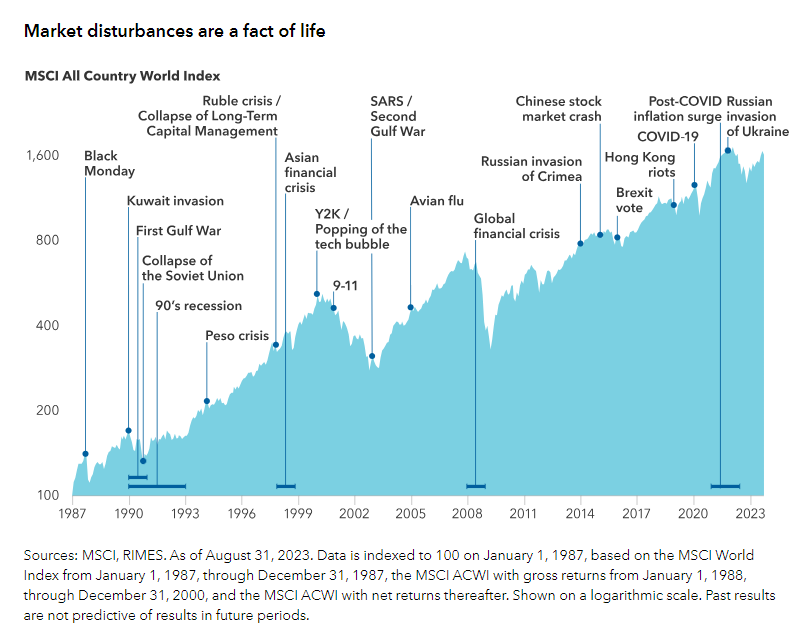
Short-term dips are normal; long-term investors focus on the overall upward journey.
Invest Early and Often: Let Time Do the Heavy Lifting
Investing early, even with small amounts, can be more powerful than investing larger sums later. This is the quiet magic of compound growth: your money earns returns, and then those returns themselves can earn returns over time. The longer you stay invested, the more chances compounding has to work in your favour.
A practical way to harness this is to invest regularly for example, monthly contributions into a globally diversified fund. This approach, often called “dollar-cost averaging,” means you buy more when prices are low and less when they are high, without needing to predict anything.
For expats whose income may be in different currencies, this steady rhythm can bring welcome structure and simplicity to your financial life.
💡 Pro Tip: Treat your investment contribution like a non-negotiable bill you pay your future self not something you do only when you “feel ready.” For help deciding what to do, you can explore this post saving vs investing as an expat.
Living Below Your Means: The Quiet Superpower Behind Investing
None of this works without a simple foundation: spending less than you earn. As an expat, it is easy to get swept up in travel, social events, and the higher cost of living in some locations. There is nothing wrong with enjoying your life abroad in fact, that is often the point. But consistently living slightly below your means creates the space to invest every month without constant stress or guilt.
I work with clients to design spending and saving plans that feel realistic, not restrictive. The goal is not perfection; it is a sustainable lifestyle where investing is built in, just like rent or school fees. That steady gap between income and spending is what funds your future choices where you live, how you work, and how much freedom you have later on.
Consistency Beats Perfection Every Time
Many people delay investing because they are waiting to feel more knowledgeable or more “ready.” The truth is that consistency matters far more than perfect knowledge or perfect timing. A simple, low-cost plan that you can follow for years will usually outperform a clever strategy you abandon after a few stressful months.
Consistency looks like this: a clear target monthly amount, automatic transfers into your investment account, a diversified portfolio aligned with your risk level and timeline, and a personal rule not to react emotionally to headlines. Over time, this calm, repeatable process builds something powerful: not just wealth, but confidence and peace of mind.
What About Market Dips and Crashes?
It is completely natural to worry about investing just before a drop. Market dips and crashes can feel frightening, especially when you are far from “home” and responsible for your own financial future. Yet these downturns are not a sign that you have failed; they are a normal part of investing.
Historically, every major crash has been followed by a recovery, even if the timing has been unpredictable. If you are investing for goals 10, 20, or 30 years away, a crash is usually a temporary chapter, not the whole story.
By continuing to invest during downturns, you are effectively buying more shares at lower prices something that can boost your long-term results, even though it feels uncomfortable in the moment.
📌 Key Takeaway: Market dips are not a signal to abandon your plan. They are a reminder of why you built a resilient, long-term strategy in the first place. If you are unsure whether your current setup is resilient enough, building a resilient expat portfolio can help you review it calmly.
So, Should You Start Investing Today?
If you have an emergency buffer, manageable debt, and some money you will not need for several years, then in most cases yes, today is a reasonable day to start. Not because today is special, but because waiting for a perfect signal usually means missing out on valuable time in the market.
Remember, you do not need to invest a huge amount or know everything on day one. You simply need a clear, honest picture of where you are, a realistic monthly amount you can commit, and a straightforward investment plan aligned with your goals as an expat.
From there, your main job is to keep going early, often, and consistently through good markets and bad.
Take Your Next Step With Support, Not Pressure
If you are still unsure how to begin, you do not have to figure it out alone. At Sail Wealth Finance, we offer transparent, commission-free coaching designed specifically for expats who want to build long-term wealth without handing control to product salespeople.
Our focus is on education, clarity, and practical steps you can actually follow not on selling you investments.
If you would like help mapping out your next financial step whether that is starting to invest, reviewing your current portfolio, or simply calming the noise in your money life you are warmly invited to book a free clarity call for 1:1 coaching.
Together, we can create a calm, realistic plan that lets you start investing with confidence, today and in every kind of market. And if you would like to read more before you book, our overview of what to expect from expat financial coaching walks you through how our work, step by step.
Enjoyed this read?
Share it with a fellow expat who keeps saying "I'll invest once things settle down." They might be waiting for permission they don't realise they need. 📥🥰
👉 www.sailwealthfinance.com/jointhenewsletter
FAQs:
1) Is now a good time to invest?
For long-term money, yes, because "now" is almost always better than "later." Nobody can time the market, so the winning move is to start and stay consistent rather than wait for a perfect moment that never actually arrives.
2) Should I wait for the market to drop before I invest?
Trying to wait for a dip usually costs you more than the dip ever would. You often end up sitting in cash for months (or years) missing out on growth. Time in the market beats timing the market.
3) What if the market crashes right after I invest?
It might. Crashes are a normal part of the ride. If your money is invested for the long term (five years plus, ideally much more), a crash is just a temporary sale, not a permanent loss, as long as you don't panic and sell.
4) How much do I need to start investing?
Less than you think. A small automatic monthly amount is a powerful beginning. The habit matters far more than the size of the first step.