
Core-Satellite Strategy for Expats: A Guide
Core-satellite Strategy, Expat Investing, Portfolio Management, Low-cost ETFs, Investment Behavior, Financial Planning
Build Your Core Before You Chase the Moons: The Core-Satellite Guide for Expats
Long-term wealth building usually isn't about finding the next big investment. It's about consistently investing into a well-built portfolio, keeping costs sensible and giving your money time to grow.
We’ll walk through how to use a friendly, practical core-satellite strategy so you can invest with confidence, and not get led by FOMO.
Why Your Core Comes First (Especially as an Expat)
Think of your investments like a solar system. Your core is the big, steady planet at the centre: globally diversified, low-cost, and designed to quietly grow over decades. Your satellites are the smaller moons that orbit around it: the more exciting, focused ideas you add on top once the core is solid.
As an expat, your life is already full of moving parts: currencies, visas, job changes, maybe even different tax rules. That’s exactly why a strong core matters so much. It gives you:
Diversificstion when markets feel unpredictable.
Simplicity so you’re not juggling dozens of random funds across countries.
Lower costs through broad, low-cost ETFs instead of expensive products pushed by commission-based salespeople.
As an expat investor myself, I see the same pattern again and again: expats who rush into individual stocks, themes or other satellites can end up with a portfolio that's more concentrated, expensive and difficult to manage than they intended.
When a portfolio becomes harder to understand, it's much easier for emotion to take over.
Those who patiently build the core first usually feel calmer, clearer, and more in control - even when markets are volatile and it boils down to a few things.
💡 Friendly reminder: If your “fun” investments are keeping you up at night, your core probably isn’t big enough yet.
What Does a Solid Core Look Like for Expats?
Your core is usually made up of a small number of diversified, low-cost ETFs that match your risk level. It’s not about being an expert; it’s about being consistent and keeping it simple. A typical expat-friendly core might include:
A global stock ETF (can include developed + emerging markets).
A global bond ETF or cash-like holding for stability.
The exact mix depends on your goals, time horizon, and how much volatility you can genuinely live with. But the spirit is the same: broad, simple, low-cost, and long term. Once that’s in place, then you potentially earn the right to play with satellites.
Note: the best thing about building a solid core first is that you learn so much about yourself and what type of investor you are. You might even realise that you don't actually want those satellite positions in your portfolio at all which is perfectly okay, you'll do just fine.
According to S&P Dow Jones Indices' SPIVA U.S. Year-End 2025 report, around 90% of U.S. large-cap funds underperformed the S&P 500 over the 15-year period ending December 31, 2025.
So rather than trying to predict economic trends, pick the next winning stock or constantly jump in and out of the market, there is a lot to be said for keeping things simple.
Build a solid core. Keep costs low. Stay diversified. Keep investing.
It reminds me of the good ol' fable of The Tortoise and the Hare 🐢
You don't need to be the fastest or the smartest in the room, you just need a plan you can stick to.
Source: S&P Dow Jones Indices SPIVA U.S. Year-End 2025
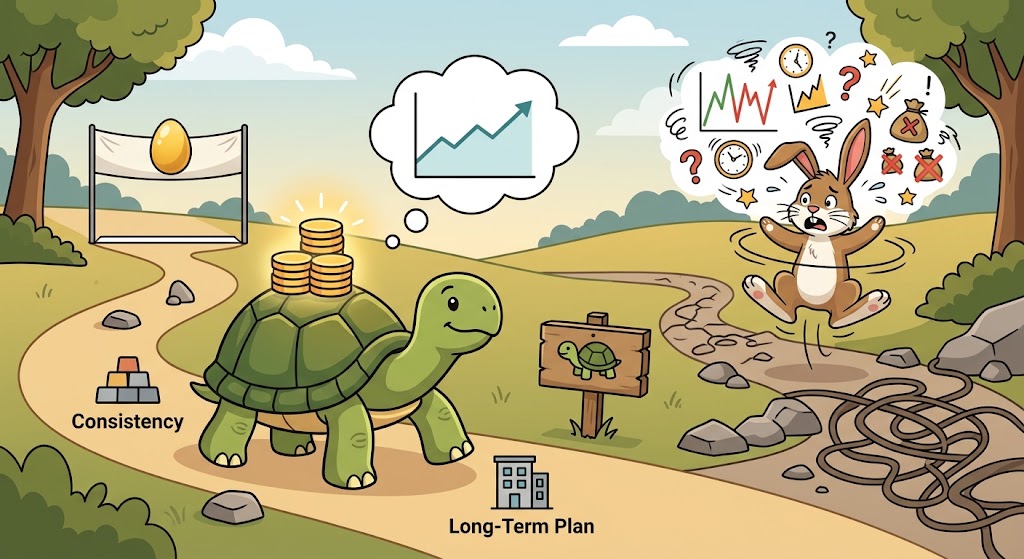
A strong core keeps your plan steady while satellites add focused opportunities.
5 Questions to Ask Before Adding Any Satellite
Before you add a new satellite - whether it’s a sector ETF, a thematic fund, or a single stock - pause and walk through these 5 questions. They’re designed to protect you from impulse decisions and market timing.
Is my core truly in place? Do I already have a diversified, low-cost core that covers global stocks and some bonds? If not, focus there first.
What clear role will this satellite play? Is it for a specific theme (e.g, clean energy), a region, or a factor (e.g, small caps)? If you can’t explain the role in one sentence, it’s a red flag.
How much of my portfolio will I allocate? Keep satellites deliberately small relative to your core. There isn't a universal percentage, but deciding on a maximum allocation before you invest can stop a small experiment from quietly becoming your entire portfolio.
What are the costs and risks? Check the ongoing fees, liquidity, and how volatile the investment can be (standard deviation). Is this aligned with your real-life tolerance for the ups and downs, not just your bravest day when everything is going well?
When and why would I sell? Know why you own it, how much you're willing to allocate, and what would make you reconsider.
📌 Key takeaway: If a satellite can’t pass these 5 questions, it doesn’t belong in your orbit yet.
Step-by-Step: How to Implement a Core Strategy as an Expat
Let’s bring this down to earth. Here’s a simple, practical way to put the core-satellite idea into practice without the drama or overwhelm.
Clarify your goals and timelines. Are you investing for long-term financial independence, kids’ education, an eventual move home, or all of the above? Timelines help you choose an appropriate risk level for your core.
Choose your core allocation. Decide what percentage of your portfolio you want in your core, and make that decision before the shiny stuff starts calling your name. Pick a simple mix of global stock and bond ETFs that you can actually stick with through market swings.
Select appropriate, low-cost ETFs. Look for broad, diversified ETFs with low ongoing fees and good liquidity. Avoid complex, opaque products that are sold with pressure or false promises. Transparency is your best friend.
Automate contributions to your core first. Set up regular monthly or quarterly investments into your core ETFs. This builds your main planet steadily, without you having to constantly “decide” on when and what to invest.
Define a clear satellite budget. Only after your core is in place, you can then ring-fence a small percentage for satellites. Treat this as your “curiosity capital” - enough to be interesting, not enough to derail your future if it goes wrong.
Review and rebalance calmly. Once or twice a year, check whether your core and satellites still match your plan. Rebalance back to your target percentages instead of reacting to headlines or social media noise.
💬 Judgment-free note: If your current portfolio is a bit chaotic, you’re not alone, that's exactly how first started. The more you learn the more you realise you actually don't need to overcomplicate this by chasing all the latest trends or next big investment "win".
You can gradually simplify toward a core-satellite structure - no need to fix everything overnight.
Bringing It All Together (And Your Next Step)
Building your core before chasing the moons isn’t about being boring; it’s about giving yourself permission to invest with clarity, calm, and confidence and that for me is worth more than gold itself.
As an expat, that solid core can be the financial anchor that lets you enjoy the adventure of living abroad - without your money life feeling like another source of chaos.
At Sail Wealth Finance, we don’t sell products or take commissions. We simply coach you - step by step - through building a low-cost, core portfolio that fits your life, your values, and your long-term plans, so you stay in control of your decisions.
If you’d like personal, practical, and judgment-free support to map out your own core plan, I invite you to book a free clarity call for potential 1:1 coaching.
Together, we’ll sketch your next financial step and start turning those distant “moons” into a grounded, long-term strategy that actually feels good to live with.